
Creating a Successful HMO on the Isle of Man: Design, Planning and Regulations
We are seeing growing interest in the conversion of suitable buildings into high-quality Housing in Multiple Occupation (HMOs) on the Isle of Man, often in preference to conversion into self-contained flats. This reflects both changing perceptions of communal living and increasing demand from renters for well-designed co-living accommodation, alongside the stronger rental yields this type of property can offer over flats when delivered successfully.
This increasing demand is being driven not only by the way people live and work in the 21st century, but also by a growing recognition of the role housing can play in supporting social connection. Many people now relocate for employment on their own, often arriving without an established social network, and it can be difficult to meet new people. This is particularly relevant on the Isle of Man, which is actively seeking to attract younger professionals from across the world. In this context, well-designed HMOs can offer more than just accommodation. By combining private space with shared living areas, they provide an immediate social circle, allowing residents to integrate more quickly and feel part of a small community from the outset. At the same time, the reuse of underutilised and, in some cases, derelict buildings presents an opportunity to deliver this type of housing in a way that also contributes positively to the built environment and regenerate town centres.

Douglas, Isle of Man - The perfect location for a co-living HMO
The concept of co-living underpins many modern HMOs. At its core, it represents a shift in how housing is structured, with residents typically having smaller private spaces ie. an en-suite bedroom, but access to larger shared amenities to an overall higher standard. These shared spaces include kitchens and lounges, but can also include shared work area, gyms and bookable spaces for residents to have their own private events.
The HMO model reflects a broader shift towards flexibility in how people choose to live and work. Many co-living arrangements offer shorter-term occupancy, reducing the need to commit to traditional long leases or find others to flat-share with. This can be particularly attractive to professionals relocating to the Island on their own, those on fixed-term contracts, and an increasing number of more mobile workers and digital nomads. Rents are often inclusive of services such as high-speed internet, cleaning and, in some cases, linen changes, reducing the day-to-day burden on residents and allowing them to focus more on work and lifestyle. In this sense, co-living is less about maximising occupancy and more about rebalancing private and shared space. The quality and usability of these shared areas becomes as important as the rooms themselves, and this has a direct influence on how successfully a building functions over time, both in terms of resident experience and long-term viability.
What is an HMO?
In simple terms, a property is considered an HMO where it is occupied by more than one household and at least one household shares basic amenities such as a kitchen or lounge. A “household” generally refers to a single person or a family unit, meaning that a HMO will be a group of unrelated individuals living together and being treated as separate households, allowing rooms to be rented on an individual basis.
What buildings work best?
In practical terms, the most suitable location for this type of accommodation is typically Douglas. This is where the majority of employment opportunities are concentrated on the island, and it also benefits from a building stock that lends itself well to conversion. Former Victorian hotels and large townhouses are common, and these buildings provide strong “architectural bones” for successful HMO schemes.
One of the key advantages of these properties is their scale. The proportions of rooms are typically generous, with high floor-to-ceiling heights and larger than average room sizes. This allows for a level of quality that would be difficult to achieve in smaller or more constrained buildings. Typically rooms can easily be reconfigured to accommodate a bedroom, dedicated area for home working, alongside an ensuite bathroom. The inclusion of ensuites is now widely expected in higher-quality HMOs and is an important factor in attracting and retaining professional tenants.
What are the key considerations?
However, creating a successful HMO is not simply a matter of subdividing a large building. The quality of the design has a direct impact on both the planning outcome and the long-term viability of the scheme. A careful balance needs to be struck between private accommodation and shared space. Residents will expect a degree of independence within their own rooms, but the shared areas, ie. kitchens and lounges, must feel considered and usable if they are to support the co-living model effectively. A further layer of complexity arises when considering the internal layout of an HMO. At first glance, it can seem logical to retain existing kitchens, bathrooms and living spaces broadly where they are, particularly in conversion projects. However, on the Isle of Man there is specific guidance governing space standards for HMOs, and this often requires a more fundamental rethinking of the building.
These standards cover not only minimum bedroom sizes, but also the provision and scale of communal spaces such as kitchens and lounges. The expectation is not simply that shared facilities are provided, but that they are appropriately sized and distributed to serve the number of occupants within the building. In practice, this can mean that a single large kitchen and living space, while seemingly desirable from a communal perspective, may not be sufficient on its own. There is typically an expectation that facilities are distributed across different floors, ensuring that occupants have reasonable access without excessive reliance on a single shared space. While this can improve usability, it also introduces additional design considerations. The inclusion of multiple kitchens on different levels has implications for fire strategy, as each becomes a higher-risk area requiring appropriate containment, detection and separation. What begins as a layout decision can therefore have a direct impact on the overall fire approach and, ultimately, on the viability of the scheme.
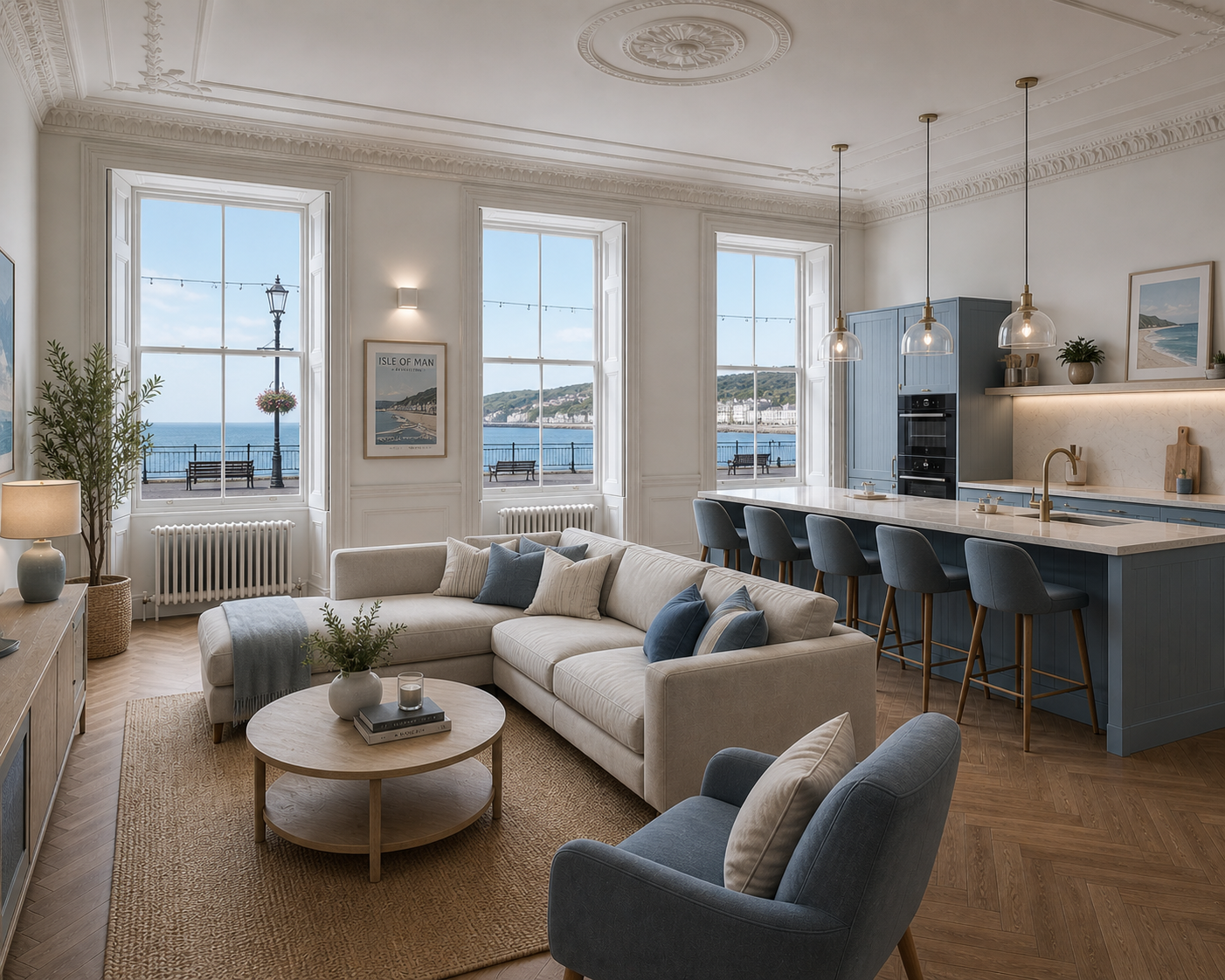
HMO Interior design concept
Alongside spatial requirements, there is also guidance relating to the provision of appliances within shared kitchens, as well as expectations around communal laundry facilities. These elements need to be considered early, as retrofitting them into an already constrained layout can be challenging. Existing plumbing routes and the stacking of services should be consider from the outset, together with any limitations created by the existing structure, such as joist direction. External requirements should not be overlooked either. Local authority expectations in relation to refuse storage and cycle provision can influence how the site is organised and how the building is accessed. In more constrained urban plots, particularly in Douglas, accommodating these elements in a way that is both practical and acceptable to the local authority can require careful planning.
Older buildings also require particular attention in terms of acoustic performance. Sound transmission is one of the most common issues in HMO accommodation, and addressing it properly often involves more than surface-level upgrades. Floors, walls and ceilings all need to be considered as part of a coordinated approach, particularly where layouts place bedrooms adjacent to shared or circulation spaces.
The existing characteristics of Victorian buildings can, however, work to an advantage. The additional ceiling height allows for the integration of modern building services, including upgraded mechanical and electrical systems, without overly compromising internal proportions. It also provides space to accommodate fire protection measures, such as sprinkler systems, and the introduction of suspended ceilings to conceal services in a coordinated manner.
What regulations should be considered?
From a regulatory perspective, HMOs on the Isle of Man are subject to specific Isle of Man planning and building control requirements, and these differ in important ways from the UK. These requirements influence everything from room sizes and amenity provision through to fire safety and means of escape. As a result, they need to be considered at the outset rather than treated as a compliance exercise later in the process.
Fire safety in particular is a central component of HMO design and is often where schemes become more complex than anticipated. On the Isle of Man, this is governed by Building Regulations Part B, alongside separate Housing HMO Regulations. Together, these establish the framework for issues such as escape routes, fire detection, compartmentation and the protection of stair cores. These requirements are not abstract, they directly influence the way a building can be planned and how many units it can realistically accommodate and in many ways, if a building is suitable for conversion at all.
One of the most important early considerations when assessing a building for HMO conversion is its overall height. This can have a significant influence on the fire strategy from the outset. In many cases, schemes with an upper floor no higher than approximately 11 metres are more straightforward to design, as this can reduce the likelihood of a secondary means of escape being required. Once this threshold is exceeded, the fire strategy typically becomes more complex, often introducing additional constraints on layout and increasing the overall cost and risk of achieving compliance within the existing building envelope.
While the Island has its own regulatory framework, it is common practice to refer to England and Wales Approved Document B as a point of comparison. This provides additional technical guidance and helps to benchmark proposals against established standards, particularly in more complex conversions where best practice and potential additional requirements from building insurers becomes an important consideration.
In this context, a working understanding of how these regulations are applied locally becomes critical. The interpretation of guidance, and the expectations of local Building Control, can have a significant impact on both design development and project outcomes. Early coordination between layout, fire strategy and building services is therefore essential, not only to achieve compliance but to avoid costly redesign later in the process.
In practice, many HMO schemes fall short because these issues are not addressed early enough. There is sometimes an initial assumption that a building can simply be subdivided to maximise the number of rooms, with compliance resolved as a secondary exercise. This approach tends to lead to compromised layouts, increased construction costs, and in some cases, difficulties in achieving planning and building regulations approvals. A more effective approach is to consider the building as a whole from the outset. Decisions around layout, servicing, fire strategy and acoustic separation are all interconnected, and resolving them early allows for a scheme that is both compliant and commercially viable. It also results in a better quality environment for residents, which ultimately underpins the long-term success of the development.
Summary
Well-designed HMOs have a clear role to play in supporting the Isle of Man’s evolving population. When delivered properly, they provide high-quality accommodation that reflects modern patterns of living while contributing to a more sustainable and socially connected housing offer. Achieving this requires a considered approach, grounded in an understanding of both the buildings themselves and the regulatory framework within which they sit.
As architects, we have experience in designing HMOs on the Isle of Man, including the conversion of existing buildings and the integration of modern co-living principles within the Island’s regulatory framework. If you are considering a project of this nature, please do get in touch - it is always beneficial to discuss proposals at an early stage.